🚧 Driving licence reform
Reform plans of the federal government
The Bundestag and Bundesrat still have to give their final approval to the driving licence law, so the reform is not yet a done deal.
Driving licence soon learnable digitally.
According to the draft, a central building block of the reform concerns the theory training for the driving licence. Driving schools should in future be free to decide whether they offer classroom instruction or whether students acquire the knowledge entirely digitally, for example via an app. A driving school does not have to offer every format, so learner drivers have to specifically look for a suitable school. The Federal Ministry of Transport also wants to cut the catalogue of exam questions, which currently contains more than 1,100 questions, by about a third.
Also new is a mandatory maturity check before the practical test, a kind of dress rehearsal under exam conditions. The actual driving test itself remains at least 40 minutes, of which at least 25 minutes are pure driving time, the European legal minimum.
(Note PEPPERMINT: Finally!)
Practising with parents.
One of the bigger innovations is an experimental clause. Novice drivers may in future gain additional driving practice on public roads under the guidance of closely trusted persons, such as parents, but only after they have passed the theory test. The law requires, among other things, at least six professional driving lessons beforehand, a joint briefing with the accompanying person, and official approval. The accompanying person must have held a class B driving licence continuously for at least seven years, may have at most one point in the driving fitness register, and may not charge money for their role.
(Note PEPPERMINT: THE SO-CALLED LAYMAN DRIVING SCHOOL. Even the wording here is problematic. People with more than 7 years of driving experience are not laymen! Besides, parents should not be presented as layman driving instructors.)
Important: This option does not automatically apply nationwide. Each federal state must first enable it by its own regulation, so availability depends on where you live. According to the explanatory memorandum, the vehicle's motor vehicle liability insurance does not yet automatically cover driving without a licence, so families must clarify with their insurer in advance whether and how they need to adjust their cover.
(Note PEPPERMINT: FEDERALISM. HOPING THERE WILL BE A NATIONWIDE UNIFORM RULE)
Transparency: A nationwide register is intended to provide more transparency, in which driving schools must in future enter their prices and pass rates, managed by the Federal Ministry of Transport. Comparison portals may use this data to offer interested parties better guidance. According to a transitional rule, existing driving schools must report their data for the first time by 1 October 2027.
(Note PEPPERMINT: TRANSPARENCY IS IMPORTANT, OUT OF THE DRIVING SCHOOL BLACK BOX)
Timetable remains staggered:
Part of the rules, for example on theory training, is to take effect on 1 January 2027, while the government plans most of the remaining provisions, including the price register and the basis for accompanied driving with relatives, only for 1 July 2027. Both dates may still shift during the further legislative process.
Whether the reform will actually lead to noticeably cheaper driving licences is seen differently by experts. (Note Peppermint: The driving licence will get cheaper!)
Criticism is voiced, among others, by the Institute for Applied Family, Childhood and Youth Research at the University of Potsdam and the Saarland University Professorship for Empirical Educational Research in a joint statement; they particularly miss binding minimum standards in training. The ADAC welcomes the greater freedom of choice, but calls for an earlier interim evaluation of accident figures than the five years provided for in the law.
Accordingly, those likely to benefit are mainly learner drivers who can learn independently, need little driving practice, and have access to a suitable vehicle along with an accompanying person. Anyone who prefers classic classroom instruction or needs more practice may have to expect smaller savings or none at all for their driving licence.
(Note PEPPERMINT: WE THINK THIS CREATES TWO CLASSES IN OUR SOCIETY AGAIN. THAT'S WHY WE DEVELOPED OUR OWN SYSTEM.)
Sources: Bundesrat, Drucksachen 330/26 & 365/26; Federal Ministry of Transport
Special drives:
In practical training, the fixed number of twelve special drives is dropped: five rural, four motorway and three darkness drives. Drives on country roads, motorways and in darkness nevertheless remain mandatory; how many hours of each are needed is in future estimated by the instructors depending on the learner driver's ability. So anyone who needs little practice saves time, while anyone who needs more practice may end up driving a similar number of hours or even more than before.
(Note PEPPERMINT: HERE WE EXPECT THE IMPLEMENTATION OF THE EU DIRECTIVE)
Sources: Bundesrat, Drucksachen 330/26 & 365/26; Federal Ministry of Transport
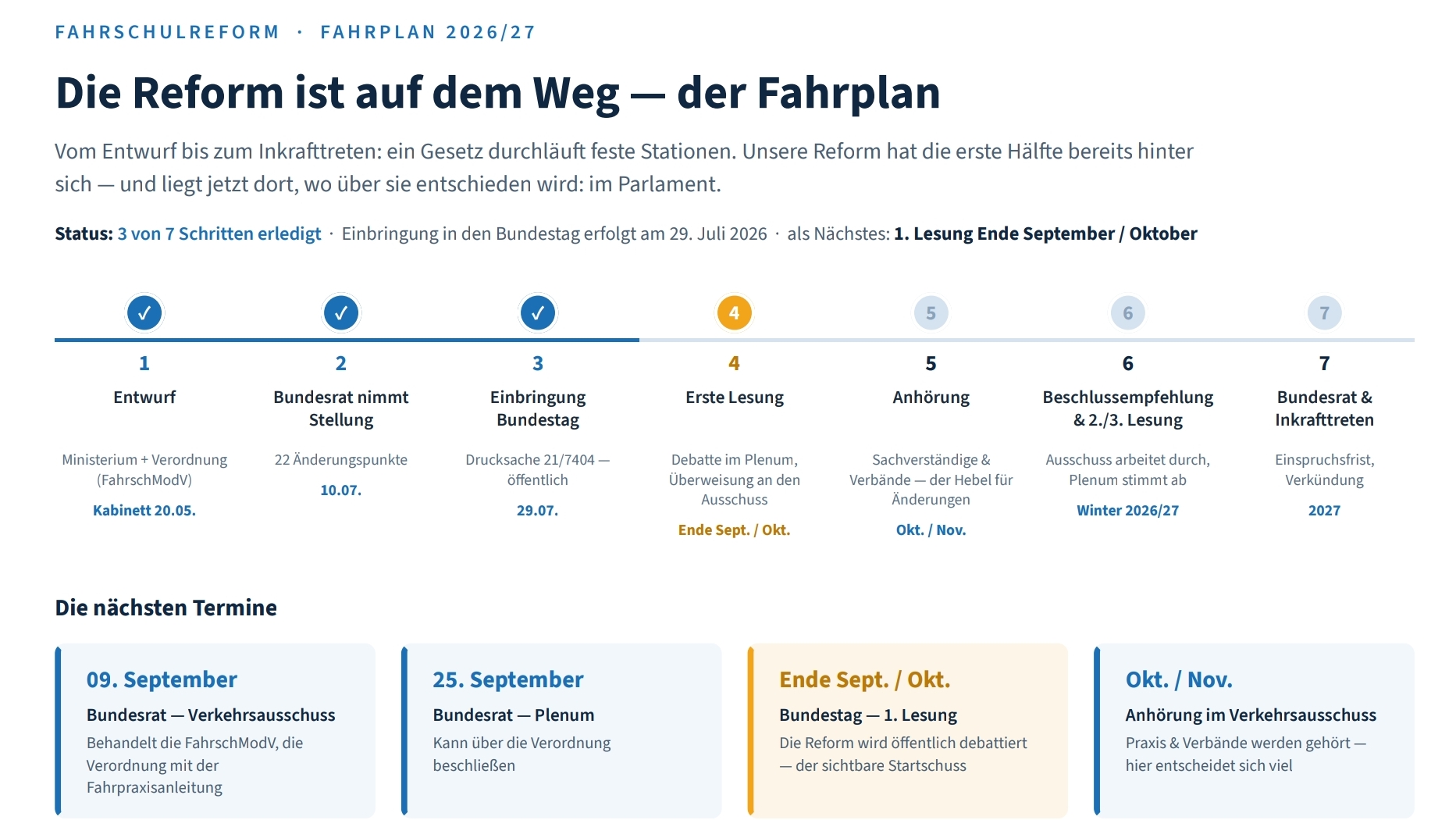
Timeline current
Currently, there are delays in the implementation of the reform.
Now it has become clear to those responsible in the government that there can be no regulation without a law.
Hmm, what does that mean for us?
The announcement by the former transport minister to bring the regulation into force on 01.01.2027 won't work, because there is no legal basis before 01.07.2027.
So the start of the driving licence reform will be at the earliest on 01.07.2027.